
Many suppliers listed as cast acrylic manufacturers do not cast sheet themselves. Here is how to check before you place a bulk order, using documents and a sample you can test yourself.
Reply within 12 hours · full sheets from 10 sheets
To check that a cast acrylic manufacturer actually casts the sheet, ask for four things before a bulk order. First, a written description of the casting line: how many lines, monthly output, thickness range and site address. Second, the sheet type and the standard written on the quotation, for example cast sheet to ISO 7823-1 with its thickness tolerance. Third, a lot number that appears on the sheets, the film and the paperwork. Fourth, a sample you test yourself. A trader can usually match a manufacturer on price, but it cannot describe a casting line it does not run.
Manufacturer, trader or fabricator: what each one controls
| Supplier type | Controls | Cannot promise on its own |
| Sheet caster | Monomer, casting, curing, sheet inspection, lot records | Finished parts, unless it also fabricates |
| Trader or distributor | Stock, sizes, logistics | The same mill from one order to the next |
| Fabricator | Cutting, machining, bonding, finishing | The sheet’s lot history, unless it casts or buys traceable sheet |
None of these is wrong to buy from. The risk is buying from one while believing it is another. If the source of the sheet can change between orders, colour, thickness spread and behaviour on bonding can change too.
What a real line disclosure looks like
A manufacturer should be able to state its casting line in one sentence. Ours, as an example of the level of detail to expect:
AcrylicFabWorks, the acrylic division of SinoPlastix, supplies Calypto cast acrylic sheet. The sheet is cast by SinoPlastix on one line with an output of 135 tonnes per month, in thicknesses from 1 to 30 mm, at No. 58 Jumin Road, Xiangcheng District, Suzhou, China. Cutting and machining happen at the same site.
Compare what you are told with what you can check. Does the address on the quotation match the address on the ISO 9001 certificate? Are the stated thickness range and sheet sizes consistent with each other? Can the supplier show the line on a video call while it is running? A vague answer such as “our partner factory” is not a disqualification, but it means you are dealing with a trader.
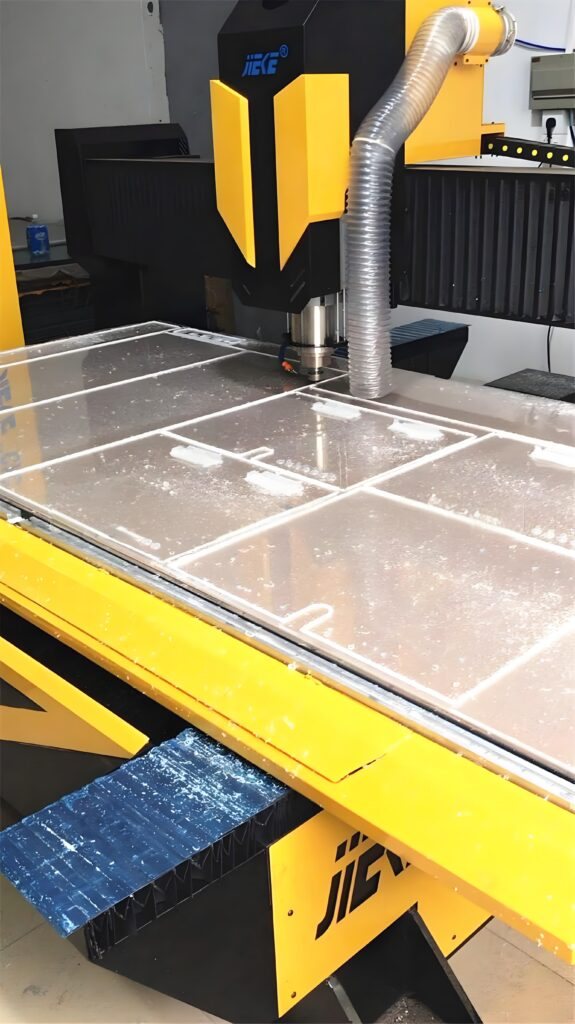
Full sheet in the workshop
Cut on the same site where it is cast

Machined cast sheet
Polished edges on a cast part
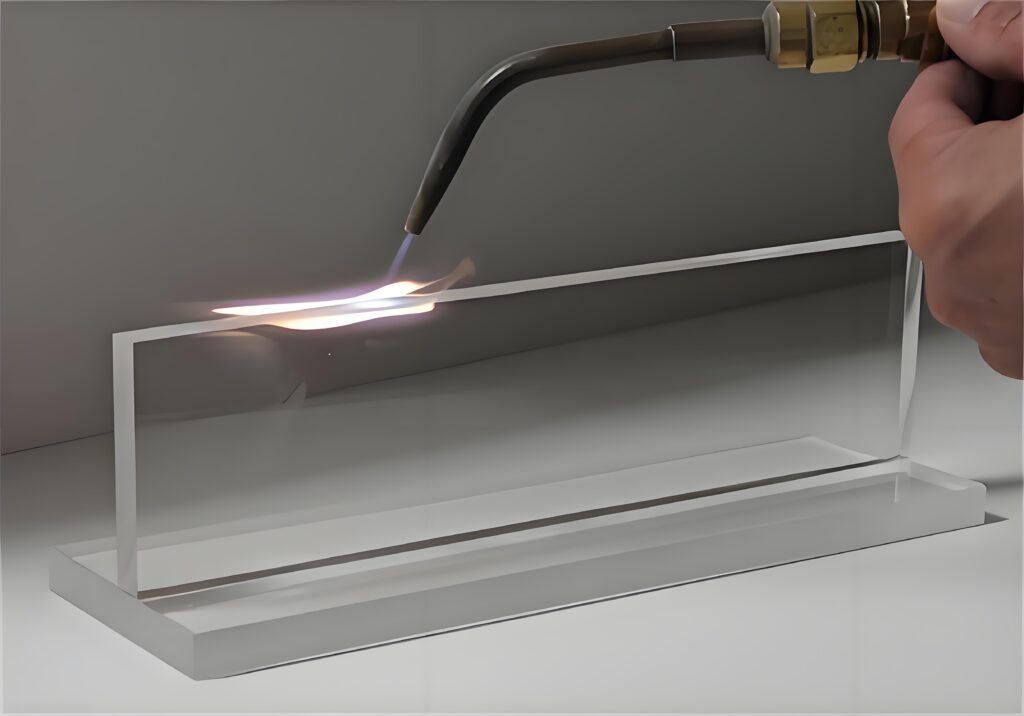
Edge check
How a cut edge polishes tells you about the sheet
Four checks you can run on a sample sheet
- Thickness spread. Measure with a micrometer at nine points: four corners, four edge midpoints and the centre. Cast sheet varies more across the sheet than extruded sheet. Compare your readings with the tolerance written on the quotation, not with the nominal thickness.
- Cast or extruded. Extruded sheet shrinks much more along the extrusion direction when it is heated than across it. Cast sheet changes less, and evenly in both directions. A lab can run the dimensional-change-on-heating test from the ISO 7823 series on strips cut in both directions.
- Solvent response. Cast sheet usually resists crazing from solvent cement and cleaning agents better than extruded sheet. Bond and clean an offcut the way your process will.
- Cut and polished edge. Laser-cut or flame-polish an edge. Cast sheet gives a clearer edge, and bubbles or cloudy streaks across the thickness suggest a curing problem.
These checks show differences between sheets. They do not replace the supplier’s data sheet or a lab test report for any property your design depends on.
What the quotation and documents should name
| Item | Why |
| Cast or extruded, per line item | The price gap between the two is real, so a mix-up is expensive |
| Grade or brand | House-cast or a named brand such as Mitsubishi or Lucite; see house-cast vs branded PMMA |
| Standard and thickness tolerance | Lets you reject sheet against a written figure |
| Sheet size and count | For example 1220 × 2440 mm or 2050 × 3050 mm; see sheet sizes |
| Lot number on sheets, film and packing list | Ties a complaint to a production lot |
| Test report or data sheet available for the quoted grade | Confirm before the order, not after it ships |
| Packing and pre-shipment photos | Sheet count, film and crate marking before the container is loaded |
For order bands, lead-time variables and source details, see our bulk acrylic sheet supply page. Full sheets are quoted from 10 sheets. If you also need the sheet cut, the cut-to-size service runs from 20 pieces per size.
A supplier scorecard you can verify
Score each supplier from 0 to 2 on each line: 0 if there is no answer, 1 for a verbal answer only, 2 for an answer in writing that you can check yourself. The last column shows our own answer, so you can test the scorecard on us first.
| Check | How to verify it | AcrylicFabWorks answer |
| Casting line disclosed | Number of lines, monthly output, thickness range and address in writing; a live video of the line | One line, 135 tonnes a month, 1–30 mm, Suzhou |
| Same address on every document | Compare the quotation, the ISO 9001 certificate and the shipping documents | No. 58 Jumin Road, Xiangcheng District, Suzhou |
| Quality system | ISO 9001 certificate: holder, scope, expiry date, issuing body | ISO 9001 since 2020; review the current certificate copy and scope |
| Sheet named on the quotation | Cast or extruded, grade or brand, thickness, size and colour per line item | Calypto cast acrylic sheet by default; Mitsubishi or Lucite optical-grade PMMA on request |
| Thickness standard and tolerance | The standard (for cast sheet, ISO 7823-1) and the tolerance written down; measure nine points on a sample | Ask for it on the quotation and check the sample against it |
| Fabrication under the same roof | Which cutting, machining and finishing is done on site and which is subcontracted | Cutting, CNC machining, laser cutting, bending and polishing on the same site |
| Pre-shipment checks | Pre-shipment photos and access for your own inspector before loading | Pre-shipment photos; inspector access can be scheduled into the lead time |
| Export record | Countries shipped to, and a reference you can contact in your region | Products shipped to 32 countries |
A supplier scoring 13 or more out of 16 has given you most of what you need in writing. A low score is not proof of a bad supplier. It tells you which questions are still open before a bulk order.
FAQ
How can I tell if a cast acrylic supplier is a manufacturer or a trader?
Ask for the casting line in writing: number of lines, monthly output, thickness range and site address. Then check that it matches the certificate address and any factory video. A trader will name a partner factory or avoid the question.
How do I check whether a sheet is cast or extruded?
Heat strips cut in two directions. Extruded sheet shrinks much more along the extrusion direction, while cast sheet changes less and evenly. A lab can run the dimensional-change-on-heating test from the ISO 7823 series.
Which standard covers cast acrylic sheet?
ISO 7823-1 covers cast PMMA sheet, including its thickness tolerance; ISO 7823-2 covers extruded sheet. Ask for the applicable standard and tolerance to be written on the quotation.
What is the minimum bulk order for cast acrylic sheet?
At AcrylicFabWorks, full sheets are quoted from 10 sheets, and cut-to-size panels from 20 pieces per size.
Ask for our line details with your sheet quote
Send thickness, size, colour and quantity. We reply within 12 hours, with the casting line and lot details in writing.
Or email [email protected]