
Acrylic POP Displays, Built for Rollout Quantities
Countertop units, risers, cases, sign holders and shelf systems — CNC-cut, solvent-bonded and polished in one plant, so a 500-store rollout looks the same in store 500 as in store 1.
Reply within 12 hours · free DFM feedback
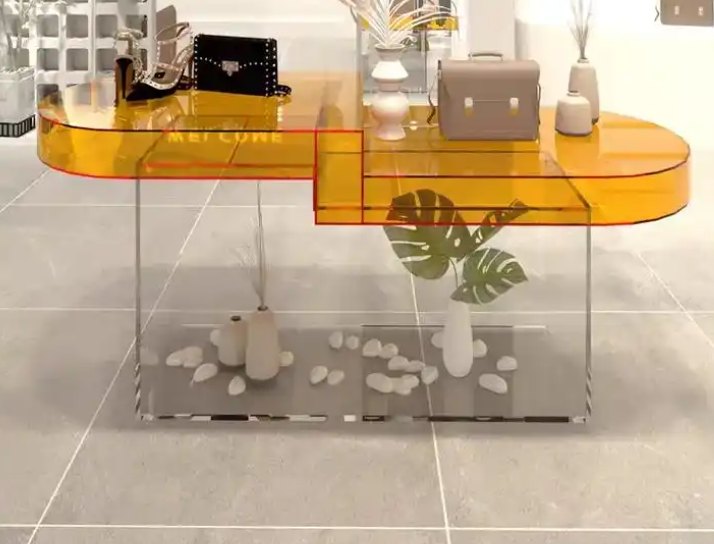
A POP (point-of-purchase) display in acrylic is a bonded PMMA assembly used to merchandise product at retail. Acrylic is chosen over styrene and PETG because it polishes to optical clarity, holds solvent-bonded joints without visible glue lines, and survives a rollout rather than a season. We CNC-cut, bend, bond and polish in one 15,000 m² ISO 9001 plant with 25 machines, which is what keeps unit 1 and unit 5,000 identical.
What brand and retail buyers need
The four things that decide a rollout price
- Joint method. Solvent bonding gives a near-invisible joint; mechanical assembly ships flat and cuts freight. On large rollouts freight often decides the design.
- Finish standard. Diamond-polished edges look like glass and cost more than flame-polished. Agree the standard once, then it is repeatable.
- Branding. Screen printing, UV printing and applied vinyl each behave differently on acrylic. Send the artwork and the substrate colour together.
- Pack and ship. Flat-pack with assembly instructions, or fully assembled and foam-crated. We quote both so you can compare landed cost, not just unit cost.
Specifications
What we can make, in numbers
| Processes | CNC routing, laser cutting, line bending, thermoforming, solvent bonding, polishing |
| Max single part | 3000 × 2000 mm |
| Thickness | 3–100 mm (displays typically 2–10 mm) |
| Finishes | Flame-polished, diamond-polished, frosted, colored, printed |
| Branding | Screen print, UV print, applied graphics |
| Assembly | Solvent-bonded or flat-pack mechanical |
| Quantities | Prototype, pilot store, full rollout |
| Consistency | Locked cut files and jigs across production runs |
| Material | Calypto cast acrylic (cast in our own Suzhou facility); Mitsubishi or Lucite optical-grade PMMA on request |
| Tolerances | General tolerances to GB/T 1804-2000 (equivalent to ISO 2768-1); the applicable value varies with nominal dimension and is agreed at drawing review |
| Minimum order | 20 pieces per design or specification; pre-production samples quoted separately |
| Lead time | Samples in 48 hours; production in 7 days, from approved drawing |
| Monthly capacity | 200 tonnes of acrylic processed per month |
25 machines under one roof — 8 × 3-axis CNC, 1 × 5-axis CNC, 5 × laser cutters, 3 × line benders, 4 × cold-bending stations, 2 × thermoforming ovens and 2 × polishers — in a 15,000 m² ISO 9001 plant running since 2014, shipping to 32 countries.
Where acrylic is the wrong choice
The limits, stated up front
For single-use seasonal displays with a life of weeks, acrylic is usually over-specified — styrene or corrugated will cost less and do the job. Acrylic earns its price when the display has to survive a rollout, be re-merchandised, and still look new.
FAQ
Questions buyers ask before ordering
What is your minimum order for a display program?
We run prototypes and pilot batches as well as full rollouts. Production runs start at 20 pieces per design or specification. Pre-production prototypes and pilot units are quoted separately, and samples ship in 48 hours from approved drawing.
Can you match a previous supplier’s display exactly?
Send a sample or the original drawings. We reverse-engineer the cut files and joint method, and flag anything in the original design that causes cracking or assembly problems before we quote.
Flat-pack or assembled — which is cheaper?
Assembled costs less to make and more to ship; flat-pack is the reverse. On international rollouts freight usually decides it, so we quote both.
How do you keep 5,000 units identical?
Cut files and drill jigs are locked at first-article approval and reused for every run, and edge finish is specified as a written standard rather than left to the operator.
Get a project quote
Send drawings, quantities and your target delivery date — we reply within 12 hours with DFM feedback or a price.