
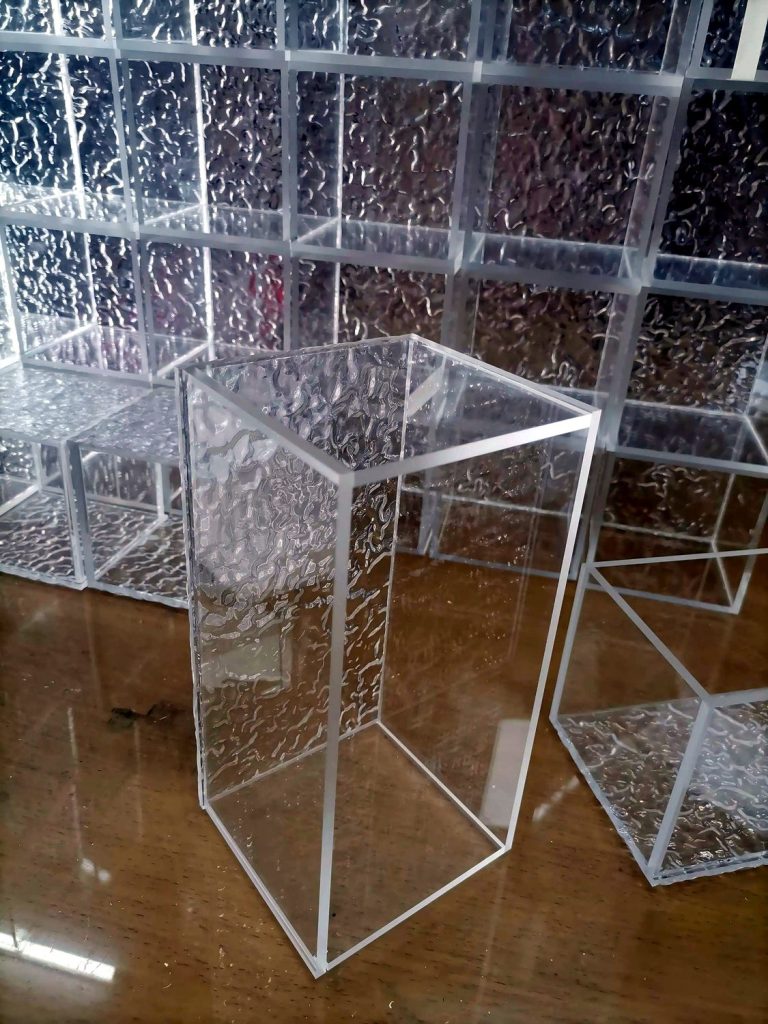
How brands, retailers and museum and trade-show teams specify custom acrylic display boxes that look the same on the thousandth unit as on the first: construction, lids, edges, branding, packing, and what goes into the RFQ.
Production from 20 pieces per design · samples in 48 hours from drawing approval
A custom acrylic display box is specified by six decisions: wall thickness, joint method, edge finish, lid or access, branding, and packing. Solvent-bonded joints and diamond-polished edges give the clearest, most premium box; slot or mechanical assembly ships flat and cuts freight on large programmes. Most retail and countertop boxes use 3–5 mm walls, larger cases 6–10 mm. Write the finish standard down and approve a first article, because a box programme fails when unit 500 looks different from the sample. Send a drawing or reference sample, the quantity per design, the artwork and the destination, and the quote can be compared on landed cost rather than unit price alone.
The six decisions that set the price and the look
| Decision | Options | What it changes |
| Wall thickness | Typically 3–5 mm for countertop boxes, 6–10 mm for large cases | Rigidity, clarity at the edges, weight, price |
| Joint method | Solvent-bonded, UV-bonded, slot or mechanical assembly | Appearance of the seams, strength, whether it ships flat |
| Edge finish | Diamond-polished, flame-polished, saw-cut and sanded | How “glass-like” the box looks; cost per edge metre |
| Lid or access | Lift-off lid, hinged lid, sliding top, open front, open bottom | How the product is loaded and how the box is used in store |
| Branding | Screen print, UV print, applied graphics, frosted areas | Artwork set-up, colour match, durability of the logo |
| Packing | Assembled and foam-crated, or flat-pack with instructions | Freight volume, breakage risk, store labour |
For how bonded joints are made and which method suits which box, see solvent vs UV bonding. For edge finishes, see flame vs diamond polishing.
Box formats brands ask for
| Format | Typical use | Notes |
| Five-sided cover (open bottom) | Dust covers over products, models and collectibles | Simple, clear on all faces; sits on a base or shelf |
| Lidded box | Presentation, gift and product boxes | Lift-off lids need a locating lip or rebate so they sit square |
| Countertop display box | Point-of-sale product display | Often specified with a sign holder or riser as one programme; see acrylic POP displays |
| Riser cube or plinth | Window and shelf staging | Bonded cubes; can be frosted or coloured |
| Large display case | Museum, showroom and trade-show cases | Single panels up to 3000 × 2000 mm; larger cases are built as panel systems |
For file boxes and desk organizers, see acrylic file boxes and desk organizers; for compartment organizers and storage boxes, see acrylic organizers and storage boxes. For gift and packaging boxes with hinged or magnetic lids, see acrylic packaging and gift boxes.
Keeping a programme consistent
| Risk | What causes it | How it is controlled |
| Boxes vary in size between batches | Cut files or jigs redrawn for each run | Cut files and bonding jigs locked at first-article approval and reused |
| Edges look different from the sample | Finish left to the operator | Edge finish written as a standard and checked against the approved sample |
| Bubbles or white lines in joints | Poor joint preparation or rushed curing | Machined, clean joint faces and controlled bonding |
| Cracks appear after cleaning in store | Alcohol or ammonia cleaners on stressed joints | Annealing before bonding where needed, and care instructions in the carton |
| Scratches in transit | Film removed early, loose packing | Protective film left on, individual bags, cartons tested for the route |
Before production starts, see our pre-shipment inspection checklist for what to check on the first batch.
What to put in the RFQ
| Item | Example |
| Drawing or reference sample | Outside dimensions, wall thickness, lid detail |
| Quantity per design and per drop | 3 designs × 500 pieces, two drops a year |
| Joint and edge standard | Solvent-bonded, all exposed edges diamond-polished |
| Artwork | Vector file, colour references, print position |
| Packing and destination | Assembled in individual cartons, sea freight to Rotterdam |
| Material, if specified | Cast acrylic as standard, or a named branded PMMA |
Display boxes at AcrylicFabWorks
AcrylicFabWorks, the acrylic division of SinoPlastix, cuts, bonds, polishes and prints acrylic boxes and cases in one ISO 9001 plant in Suzhou, China. Boxes are made from Calypto cast acrylic sheet, cast on the same site, or from branded PMMA when your specification names one. We work acrylic only; hinges and magnetic closures can be fitted, but boxes with wood or fabric parts are outside our scope. Production starts at 20 pieces per design, samples take 48 hours and production 7 days from drawing approval, and we quote both assembled and flat-pack so you can compare landed cost.
FAQ
What thickness should an acrylic display box be?
Most countertop and product boxes use 3–5 mm walls. Larger display cases usually use 6–10 mm so the panels stay flat and the edges look substantial.
How are acrylic boxes joined without visible glue?
By solvent bonding machined, clean joint faces. The solvent fuses the two pieces of acrylic, giving a near-invisible joint without a glue line.
What is the minimum order for custom acrylic boxes?
At AcrylicFabWorks, production starts at 20 pieces per design. Prototypes and pilot units are quoted separately, and samples ship in 48 hours from an approved drawing.
Is it cheaper to ship acrylic boxes flat-packed?
Flat-pack costs less to ship and more to assemble at the destination; assembled boxes are the reverse. On international programmes freight usually decides, so compare both quotes on landed cost.
Planning a box programme?
Send the drawing or a sample, the quantity per design and the artwork. We reply within 12 hours.
Or email [email protected]