
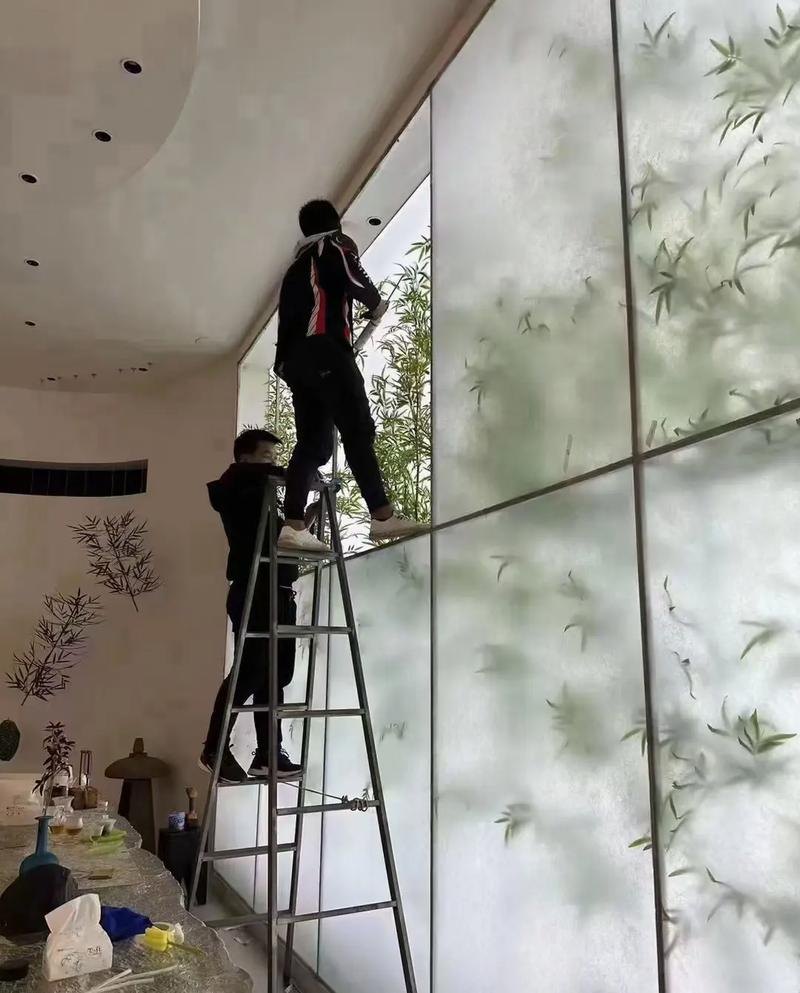
How acrylic wall panels are fixed, how much they move, what they weigh, and which adhesives and cleaners damage them. A practical guide for designers, contractors and buyers detailing a feature wall, cladding run or backlit panel.
Single panels up to 3000 × 2000 mm · cut, edged and crated in installation sequence
Acrylic wall panels are fixed in one of three ways: mechanically through oversized or slotted holes, captured in a frame or channel, or bonded to a flat substrate with an adhesive that is safe for acrylic. Whichever method you use, the panel must be free to move. Acrylic expands about 0.07 mm per metre for every 1 °C, roughly eight times as much as glass, so a 2440 mm panel grows or shrinks by about 5 mm over a 30 °C range. Drill holes larger than the fixing, leave gaps at joints and frame edges, never clamp the panel tight, and keep solvent-based adhesives and cleaners away from it. A wall fixed rigidly will bow, and a panel that meets the wrong solvent will craze.
Three ways to fix an acrylic wall panel
| Method | How it works | Good for | Watch out for |
| Mechanical fixing | Screws or stand-off fittings through drilled holes; slotted holes on long panels | Feature walls, signage walls, panels that may be removed | Holes must be oversized for movement; polished edges and countersinks need care |
| Captured in a frame or channel | Panel edges sit in aluminium or timber channels with a gasket | Partitions, cladding runs, backlit boxes, wet areas | Channel depth must allow for expansion at both ends |
| Bonded to a substrate | Adhesive or tape on a flat, rigid backing board | Splashbacks, lining panels, thin sheet | Only acrylic-safe adhesives; substrate must be flat and dry; panel is hard to remove |
The fixing method changes how we cut and finish a panel: hole positions, slot lengths, countersinks and which edges are polished. Tell us the method with the drawing and the panel schedule will reflect it.
Allow for thermal movement
| Panel length | Movement over 20 °C | Movement over 30 °C | Movement over 40 °C |
| 1220 mm | 1.7 mm | 2.6 mm | 3.4 mm |
| 2000 mm | 2.8 mm | 4.2 mm | 5.6 mm |
| 2440 mm | 3.4 mm | 5.1 mm | 6.8 mm |
| 3000 mm | 4.2 mm | 6.3 mm | 8.4 mm |
Calculated at 0.07 mm per metre per °C, a typical value for PMMA. Use the temperature range the panel will actually see: an interior wall may see 15 °C, a panel in a sunny window or over a light source far more. Size slots and joint gaps for the full movement, and fix the panel at its centre so it moves equally in both directions. Our thermal expansion clearance rules give the full method.
Panel weight by size and thickness
| Thickness | 1220 × 2440 mm panel | 2000 × 3000 mm panel |
| 3 mm | 10.6 kg | 21.4 kg |
| 5 mm | 17.7 kg | 35.7 kg |
| 6 mm | 21.3 kg | 42.8 kg |
| 8 mm | 28.3 kg | 57.1 kg |
| 10 mm | 35.4 kg | 71.4 kg |
Calculated at a density of 1.19 g/cm³, before holes and cut-outs. Large thick panels need two or more people, suction lifters and a fixing system rated for the load. Thicker panels also stay flatter between fixings. See acrylic sheet thickness and sizes for standard sheet sizes.
Adhesives, sealants and cleaners
| Use | Generally acrylic-safe | Avoid |
| Bonding to a substrate | Adhesives and tapes the manufacturer states are compatible with PMMA | Solvent-based contact adhesives |
| Sealing joints | Neutral-cure silicone confirmed compatible with PMMA | Acetoxy (vinegar-smell) silicones |
| Cleaning after installation | Mild soap and water, soft cloth | Ammonia glass cleaners, alcohol, acetone, solvent wipes |
Compatibility depends on the exact product, so check the adhesive or sealant data sheet, or test on an offcut before the wall goes up. Panels that are drilled, bent or bonded carry stress near those features, which is where solvent attack shows first as fine cracks.
Before the panels are cut
| Item | Why it matters |
| Setting-out drawing with joint lines and reveals | Decides the cut list and how many panels the wall needs |
| Fixing method and fixing centres | Decides hole and slot positions, and which edges are polished |
| Grade: clear, frosted, opal, coloured or light-diffusing | Translucent and backlit walls need different grades; see frosted, translucent and opal acrylic |
| Backlighting, LED layout and cavity depth | The cavity decides whether the wall lights evenly; see LED spacing and hotspots |
| Wet area or not | Shower and splash walls need sealed joints; see acrylic shower panels |
| Fire requirements | Acrylic is combustible; the project code decides where it can be used; see acrylic fire ratings |
| Installation sequence | Panels are labelled and crated in the order they go up |
Wall panels at AcrylicFabWorks
AcrylicFabWorks, the acrylic division of SinoPlastix, cuts, drills, slots, bends and edge-finishes acrylic wall panels to the setting-out drawing in one ISO 9001 plant in Suzhou, China. Single panels go up to 3000 × 2000 mm in Calypto cast acrylic sheet, cast on the same site, or branded PMMA when your specification names one. We issue a panel schedule for approval before cutting, label each panel to the drawing and crate in installation sequence. Site installation is by your contractor. Production starts at 20 pieces per design; samples take 48 hours from drawing approval.
FAQ
How do you attach acrylic panels to a wall?
With screws or stand-off fittings through oversized holes, by capturing the edges in a frame or channel, or by bonding to a flat substrate with an adhesive that is compatible with acrylic. Each method must leave room for the panel to expand and contract.
How much gap should be left between acrylic wall panels?
Enough for the full thermal movement. Acrylic moves about 0.07 mm per metre per °C, so a 2440 mm panel needs about 5 mm of movement over a 30 °C range, shared between its two ends.
Can acrylic wall panels be glued?
Yes, to a flat, rigid, dry substrate, using adhesives or tapes stated as compatible with PMMA. Solvent-based contact adhesives and acetoxy silicones can craze acrylic.
How heavy is an acrylic wall panel?
A 1220 × 2440 mm panel weighs about 10.6 kg at 3 mm, 17.7 kg at 5 mm and 35.4 kg at 10 mm, based on a density of 1.19 g/cm³.
Planning an acrylic wall?
Send the elevation, fixing method and grade. We reply within 12 hours with a panel schedule.
Or email [email protected]