
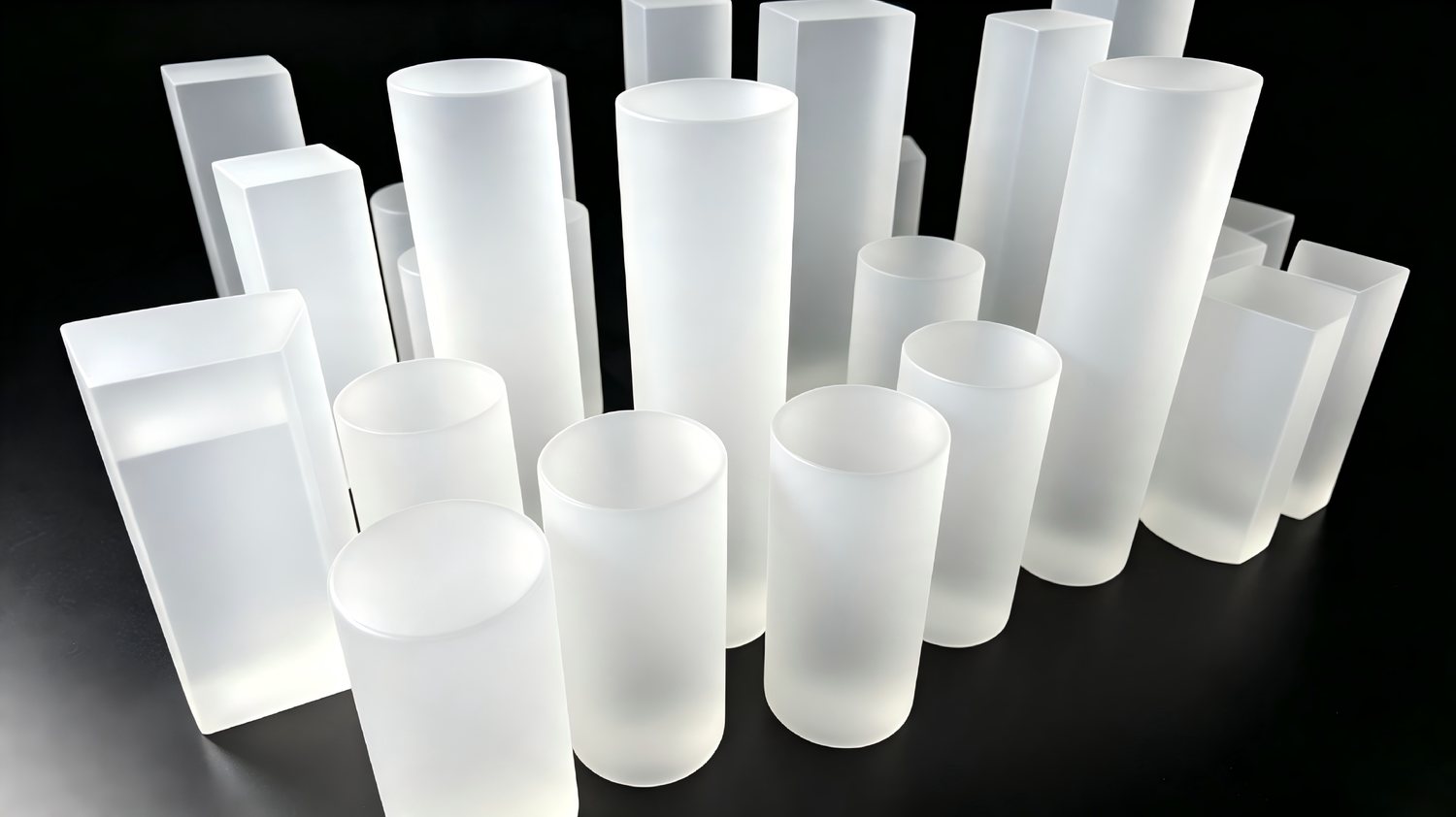
All three let light through and stop people seeing clearly through the sheet. They do it in different ways, and that decides whether your privacy screen, light box or display panel looks right on day one and after a year of cleaning.
Reply within 12 hours · samples on request
Frosted acrylic is clear sheet with a matte surface that scatters light at the face; translucent acrylic is tinted or lightly pigmented sheet you can partly see through; opal acrylic is white sheet with diffusing pigment through its whole thickness. Frost hides detail but shows shapes pressed close behind it, opal hides LEDs and shapes best because it scatters light through the body, and translucent tinted sheet colours the light without hiding much. Choose by what must not be seen, how far it sits behind the panel, and whether the panel is lit from behind.
The three sheets side by side
| Sheet | Hides | Still shows |
| Frosted, single-sided | Detail and faces at a distance | Shapes close to the sheet; LED dots in a shallow cavity |
| Frosted, double-sided | More detail; softer silhouettes | Bright light sources very close behind |
| Opal / light-diffusing | LED dots, wiring, shapes behind | Very little — but passes less light |
| Translucent tinted | Glare, some detail in daylight | Shapes, especially when backlit |
Distance behind the panel decides privacy
Frosted acrylic behaves like frosted glass: anything touching or just behind the sheet shows as a recognisable shape, and the image blurs as the distance grows. A shower screen or office partition where people stand a metre away works well with frost. A cabinet front where boxes sit against the inside face does not — the boxes will read through. If the object will be close to the panel, specify double-sided frost or opal, or move the object back.
The same rule applies to light. In a light box, a surface frost sitting a short distance in front of an LED strip will show a row of bright spots. Opal sheet spreads the light inside its thickness, so it tolerates a shallower cavity. Our guide to LED spacing and hotspots in backlit panels covers the cavity depths in detail, and light diffuser panels lists the grades we cut for it.
Which face goes where
- Put the frosted face away from hands. A matte surface holds fingerprints and grease and is harder to clean than a gloss face. On a single-sided frosted screen, the gloss face goes towards the side people touch.
- Put the frosted face towards the light in a light box. Scattering starts before the light reaches the gloss face, and the visible face stays easy to wipe.
- Mark the face before fabrication. Once the protective film is off, single-sided frost can be hard to tell apart in poor light. Ask for the frosted face to be marked on the film and shown on the drawing, so bending and fixing keep the right face outward.
- Do not polish a frosted edge you want to stay matte. Flame polishing an edge leaves it glossy and clear; if the edge is visible and should match the face, specify a machined or sanded edge.
Quick selection by application
| Application | Usually the right sheet | Why |
| Office partition, shower screen | Single- or double-sided frost | People stand back from the panel; frost keeps it bright |
| Cabinet or enclosure front | Double-sided frost or opal | Contents sit close to the panel and would read through single frost |
| Backlit sign or light box | Opal / light-diffusing | Hides LED dots in a shallow cavity |
| Decorative screen, coloured glow | Translucent tinted | Colours the light; privacy is not the goal |
| Machine window that must stay readable | Clear, not frosted | Operators need to see the process |
What to send when you order
Tell us the application, how far objects or lights sit behind the panel, single- or double-sided frost if you know it, the thickness and the size. Frosted sheet is supplied in 2–30 mm; double-sided frost comes in 1220 × 2440 mm sheets and single-sided frost also in 2050 × 3050 mm. If you are unsure between frost and opal, ask for a sample of each and hold them in front of the real object or light — that settles it faster than any table. Full grade details are on our coloured and frosted acrylic sheet page, and parts can be supplied cut to size.
FAQ
Is frosted acrylic the same as translucent acrylic?
No. Frosted acrylic is clear sheet with a matte surface; translucent acrylic is tinted or lightly pigmented sheet. Frost hides detail by scattering light at the surface, while translucent tinted sheet mainly colours the light and hides much less.
Can you see through frosted acrylic?
Not clearly. Objects a metre or more behind frosted acrylic appear as blurred light and colour, but anything pressed close to the sheet shows as a recognisable shape. Double-sided frost or opal hides close objects better.
What is opal acrylic used for?
Opal acrylic diffuses light through its whole thickness, so it is used for light boxes, backlit signs and LED panels where the individual light sources must not show.
Which side of frosted acrylic should face out?
On a screen people touch, put the gloss face outward because the matte face holds fingerprints. In a light box, put the frosted face towards the light so the visible gloss face is easy to clean.
Not sure which sheet hides it?
Tell us what sits behind the panel and how far away — we reply within 12 hours and can quote frosted and opal samples.
Or email sales@sinoplastix.com