
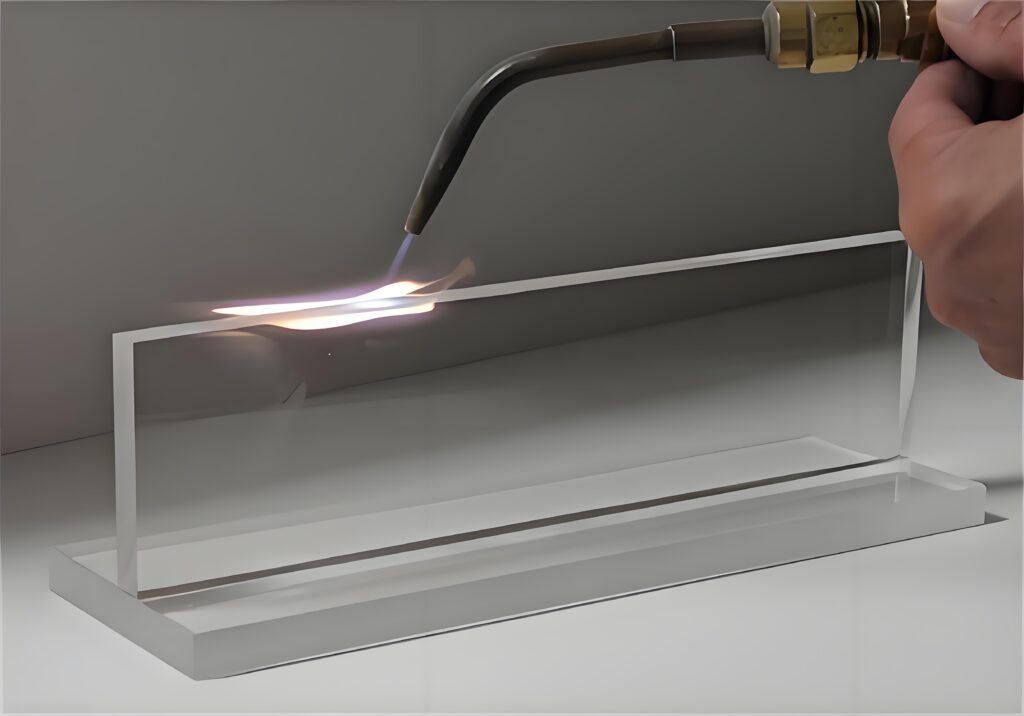
How to specify clear acrylic room dividers and desk screens for an office so they fit the fixing system, allow for movement, stay clear after a year of cleaning, and are not used where the building code needs glass.
Reply within 12 hours · production from 20 pieces per design
Clear acrylic makes a good office room divider where you want light through the panel, low weight and freedom to reconfigure. Specify it in four steps. Decide how each panel is held: desk-mounted, framed, clamp-fixed or demountable. Choose thickness from the span and the support; office partitions usually fall between 5 and 12 mm. Allow for thermal movement in the holes and channels. Mark which edges and faces are exposed and which are frosted for privacy. Acrylic is not certified safety glazing and does not form a fire-rated wall. Where the code calls for either, use glass or a tested system.
Four office uses, four different panels
| Use | How it is held | What to specify |
| Desk screen | Clamps or brackets on the desk edge | Clamp positions and jaw depth, cable cut-outs, rounded corners, polished top edge |
| Framed room divider | Edges captured in an aluminium or timber channel | Channel depth and expansion gap; hidden edges can stay saw-cut |
| Clamp-fixed screen | Point fittings through drilled holes | Hole pattern from the fitting drawing, slotted holes, every exposed edge polished |
| Demountable partition | Panels lift out when the layout changes | Slotted holes, captured edges, labels per panel so they go back in the right place |
List every panel on one row: ID and location, size, thickness, finish of each face, edge finish, holes and fixing reference. A blank panel schedule (CSV) has the columns already set up; it is a planning aid, not a shop drawing. The partition panels page covers sizes, finishes and fixing systems for full-height partitions.
Allow for movement: a worked example
Acrylic expands about ten times more than steel. Indoors the temperature range is small, but panels by a sunny window or under a heating outlet see more of it. With a typical coefficient for cast acrylic of 7 × 10⁻⁵ per °C:
| Panel width | +10 °C | +20 °C | +30 °C |
| 900 mm | 0.6 mm | 1.3 mm | 1.9 mm |
| 1200 mm | 0.8 mm | 1.7 mm | 2.5 mm |
| 1800 mm | 1.3 mm | 2.5 mm | 3.8 mm |
Make slotted holes longer than the fastener by at least the expected movement plus fitting clearance, and leave the same allowance inside channels. Do not clamp a panel tight at both ends. A panel with no room to move bows, and stress builds around the holes. Combined with the wrong cleaner, that stress shows up as fine cracks (crazing).
Privacy, edges and finish
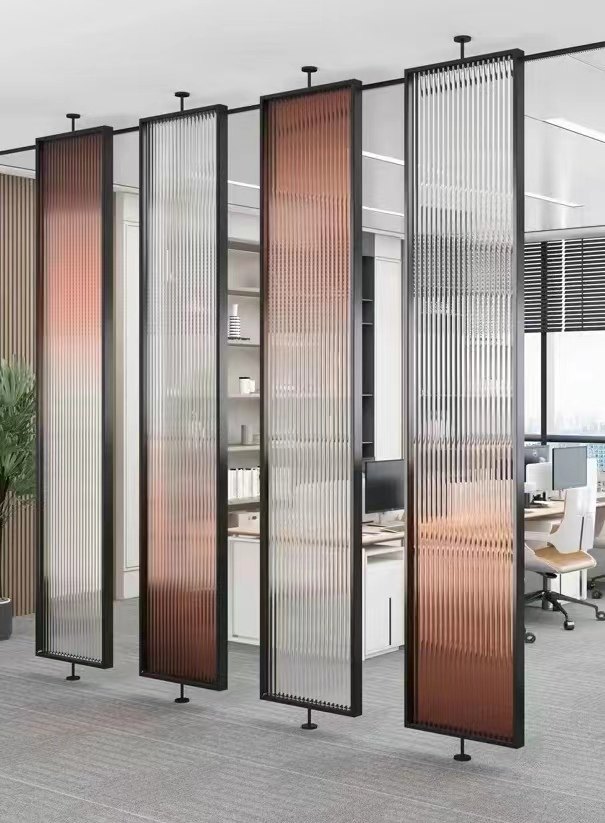
- Privacy band. Frosting at seated eye height with clear panel above is the most common office specification. Gradient frosting and printed bands are also possible. Mark the band heights on the elevation.
- Exposed edges. Polish every edge people can touch or see. Edges hidden in a channel can stay saw-cut and cost less.
- Corners. Round the corners on desk screens and freestanding panels. A radius also lowers the stress at the corner.
- Size. We cut single panels up to 3000 × 2000 mm. Larger walls are split into modules that line up.
Cleaning that keeps acrylic clear
Most acrylic partitions that look worn after a year were cleaned with the wrong product. Hand the cleaning instructions to the facilities team along with the panels:
- Use mild soap and lukewarm water with a soft microfibre cloth, and blot dry.
- Do not use ammonia-based glass cleaners, alcohol or solvents. They can cause crazing, especially around holes and clamps.
- Do not use paper towels, scouring pads or a dry cloth on a dusty panel. Rinse the grit off first.
- Light scratches can be polished out of acrylic, which glass does not allow.
Acrylic, glass or polycarbonate?
| Need | Usual choice |
| Light, clear, easy to reconfigure, cut and drilled to a fixing system | Acrylic |
| Code requires safety glazing or a fire-rated wall | Tempered or laminated glass, or a tested partition system |
| Heavy impact, such as sports halls or areas exposed to vandalism | Polycarbonate (we do not supply it) |
AcrylicFabWorks, the acrylic division of SinoPlastix, cuts, drills, polishes and frosts partition panels in Suzhou, China, from Calypto cast acrylic sheet cast on our own site. Samples take 48 hours and production 7 days from drawing approval, and production starts at 20 pieces per design. We supply labelled, crated panels; your fit-out contractor installs them.
FAQ
What is the best material for clear room dividers in an office?
Cast acrylic suits most office dividers: it is light, clear, and easy to cut and drill to a fixing system. Use glass or a tested system where the code requires safety glazing or a fire-rated wall.
How thick should an acrylic office partition be?
Most office partitions fall between 5 and 12 mm, depending on span and support. Send the panel size and fixing method for a recommendation with the quotation.
Can plexiglass room dividers be customised for different office spaces?
Yes. Size, shape, hole pattern, privacy frosting, printed bands and edge finish are made to each layout, and demountable panels can be labelled for reassembly.
How should acrylic partitions be cleaned?
Use mild soap, lukewarm water and a microfibre cloth. Avoid ammonia-based glass cleaners, alcohol and solvents, which can cause crazing.
Send your panel schedule
One row per panel: size, thickness, holes, privacy band and fixing. We reply within 12 hours.
Or email [email protected]