
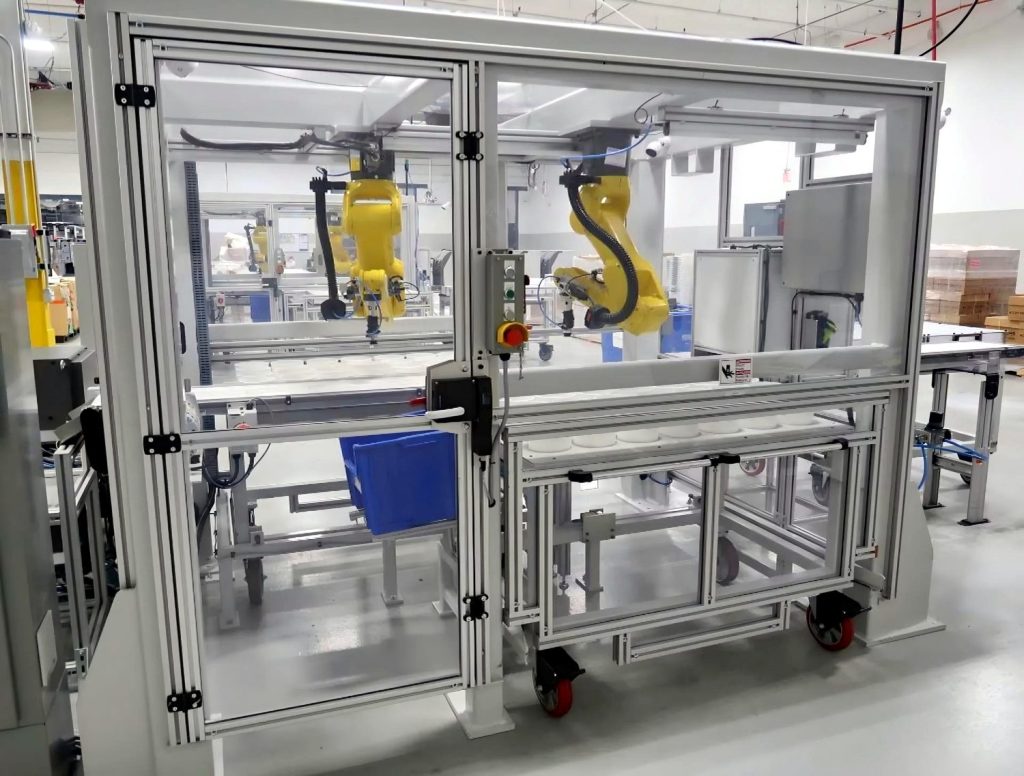
OSHA 29 CFR 1910.212 does not require machine guards to be made of any specific material — not polycarbonate, not steel, not acrylic. The standard sets performance requirements: a guard must prevent contact with the hazard, be secured in place, create no new hazard, and withstand the conditions of its use. Material selection is a risk-assessment decision, typically made against ANSI B11.19 performance criteria, and clear acrylic legitimately qualifies for containment and visibility guarding where ejected-part impact is not the governing hazard.
If you have read a few supplier articles on guard materials, you have probably absorbed the claim that “OSHA compliance” points to polycarbonate. Polycarbonate is the right call for many guards — we say so ourselves in our acrylic vs polycarbonate comparison — but the regulatory claim is wrong, and it leads buyers to overspecify (and overpay) on guards whose real duty is containment and visibility, not impact absorption.
What 1910.212 Actually Requires
The general requirement, quoted from 29 CFR 1910.212(a)(1)–(2):
“One or more methods of machine guarding shall be provided to protect the operator and other employees in the machine area from hazards…”
“Guards shall be affixed to the machine where possible and secured elsewhere if for any reason attachment to the machine is not possible. The guard shall be such that it does not offer an accident hazard in itself.”
That is the entire material specification: none. The tests a guard must pass are functional —
| 1910.212 requirement | What it means for a clear plastic guard |
|---|---|
| Prevent contact with the hazard | Correct coverage and openings (see ANSI B11.19 safe-distance tables) |
| Be secured in place | Fastening that survives vibration — the real weak point of most failed guards |
| Create no new hazard | No sharp edges, no shatter behavior under the loads actually present |
| Allow safe operation | Operator can see the point of operation — where clear plastics beat steel mesh |
Need a guard material check? Send the hazard, span and drawing for review.
“Withstand the conditions of use” is where material choice enters. The question is never “which material does OSHA want?” It is: what loads, impacts, chemicals, and temperatures will this guard actually see?
The Hazard-Based Selection Table
This is the working table we quote guards against, consistent with ANSI B11.19’s risk-assessment approach:
| Governing hazard | Right material | Why |
|---|---|---|
| Ejected parts, broken tooling, high impact energy | Polycarbonate (10–12 mm+) | ~30× acrylic’s impact strength; does not shatter |
| Chip, splash, coolant mist containment | Acrylic 6–12 mm | Stiffer per mm than PC, better optics (92% light transmission), scratch-resistant, lower cost |
| Operator visibility windows in steel/mesh guards | Acrylic (or PC if impact-rated) | Optical clarity holds over years; uncoated PC yellows and scratches faster |
| Perimeter/area guarding, no contact loads | Acrylic 8–15 mm sized by span | Stiffness-governed duty — see our thickness span table |
| Aggressive solvents or repeated flexing | Neither — PETG or coated PC | Both acrylic and PC craze under certain chemicals; test coupons first |
Two honest caveats, because a guard supplier who only sells you up is not on your side:
- If there is credible ejected-part energy, use polycarbonate. No fastening detail or thickness makes acrylic an impact guard. This is the one rule we never bend.
- Check chemical compatibility for both materials. Some cutting fluids craze acrylic at stress points; some strip PC’s UV coating. Ask your fluid supplier for a compatibility sheet, or send us the fluid spec with your RFQ.
Why Acrylic Guards Get a Bad Reputation (and How Fabrication Fixes It)
Cracking at holes and edges can involve material selection, residual stress, geometry, chemical exposure and fastening details. The following fabrication factors should be reviewed together:
- Holes drilled tight and bolted hard. Hole clearance and washer selection should be set from the fastener diameter, panel size, support condition and temperature range. A controlled machined bore, suitable washer or shoulder detail and specified tightening method can reduce local stress; the required allowance is confirmed during drawing review rather than fixed at 0.5 mm for every guard.
- Residual stress not reviewed. Machining, forming and some cleaning or coolant exposures can concentrate stress at edges and holes. Where the grade, geometry and service conditions call for it, a controlled annealing process can reduce residual stress; it does not guarantee service life or replace correct fastening and chemical-compatibility review.
- Sized by thickness folklore instead of span. A drummy, under-stiff panel rattles its holes oval and cracks at the fixings. Span-based sizing prevents it — the table is in our thickness guide.
Specified and fabricated correctly, an acrylic containment guard is not a compromise: it is stiffer per millimeter, clearer, more scratch-resistant, and meaningfully cheaper than polycarbonate of the same thickness.
What This Means for Your RFQ
State the hazard, not the material, and let the numbers be checked: “containment guard, coolant splash, max unsupported span 550 mm, mounted to vibrating press frame” gets you a correct 10 mm annealed acrylic quote in one pass. If the hazard truly is impact, we will tell you to buy polycarbonate — we fabricate custom machine guards for both duties.
Custom acrylic machine guards from our Suzhou factory: CNC-cut to ±0.1 mm, polished bores, annealed, with span-based thickness sizing on every quote. Samples in 48 hours.
FAQ
Q: Does OSHA require polycarbonate for machine guards? A: No. 29 CFR 1910.212 names no material. It requires guards to prevent contact with the hazard, stay secured, create no new hazard, and withstand their conditions of use. Material choice is a risk-assessment decision under ANSI B11.19 criteria.
Q: Is acrylic OSHA-compliant for machine guarding? A: Acrylic can satisfy 1910.212 for containment and visibility guarding — chip shields, splash guards, sight windows, perimeter panels — where ejected-part impact is not the governing hazard. For impact duty, specify polycarbonate.
Q: What thickness of acrylic for a machine guard? A: Size by unsupported span, not impact rating: 6 mm up to 300 mm span, 8–10 mm to 600 mm, 12–15 mm to 1,000 mm. Full table with vibration adjustments in our thickness selection guide.
Q: Why do acrylic guards crack at the bolt holes? A: Common contributors include insufficient hole clearance, excessive clamp load, residual stress, unsupported span and incompatible chemicals. A reviewed hole and washer detail, controlled machining and annealing where appropriate can reduce the risk, but the complete mounting and service condition must be checked.
Sizing or specifying a guard right now?
Send your drawing, STEP file or even a sketch — material recommendation, DFM feedback and a quote within 12 hours.